Pompeii Forum panorama — Public domain, via Wikimedia Commons
Top Things to Do in Naples — Complete Guide 2026
Naples is a city that doesn't do half-measures. From a volcano that buried two Roman cities to a marble veil so realistic you'll swear it moves, from streets that split the city in two to pizza that rewired the world's palate — here's everything you need to do in Italy's most thrilling city.
The Big Attractions
1. Pompeii Archaeological Park
Pompeii is not an attraction — it's a city. A full Roman city of 11,000 people, frozen on 24 August AD 79 when Vesuvius erupted with the force of 100,000 Hiroshima bombs, burying the town under 4–6 metres of ash and pumice. What emerged from excavation in the 18th century was unprecedented: streets, houses, shops, brothels, baths, temples, and an amphitheatre — all intact enough to walk through, 2,000 years later.
The site covers 66 hectares, of which roughly two-thirds have been excavated. Key stops for a first visit: the Forum (the civic and religious heart, with Vesuvius looming behind), the House of the Faun (Pompeii's largest private residence, with the famous Alexander Mosaic — the original is in the Naples Archaeological Museum), the Amphitheatre (the oldest surviving Roman amphitheatre, built 70 years before the Colosseum), the Villa dei Misteri (just outside the walls, with extraordinary Dionysiac frescoes in vivid red), and the Lupanar (the brothel, with its graphic frescoes still intact — essentially an ancient menu of services). The plaster casts of victims — bodies that left voids in the ash, filled with plaster during excavation — are scattered across the site and are deeply moving.
Practical: Circumvesuviana train from Napoli Centrale to Pompei Scavi–Villa dei Misteri (35 min, €3). Entry €19 (book online at ticketone.it). Open 9:00–19:00 (summer), 9:00–17:00 (winter, last entry 15:30). Allow 4 hours minimum — 6 is better. Bring water, wear a hat (there is almost no shade), and download a map or audio guide in advance — the site is large and signage is limited. Combine with Herculaneum (Ercolano Scavi station, 20 min from Naples) for a smaller, better-preserved site that complements Pompeii perfectly.
2. Cappella Sansevero — The Veiled Christ
If you see one thing in Naples that isn't pizza, make it the Veiled Christ (Cristo Velato). Giuseppe Sanmartino carved this life-sized figure of Christ in 1753 from a single block of marble, and the translucent shroud draped over the body is so perfectly realised — the folds, the way it clings to the features beneath, the sense of fabric — that generations of visitors have refused to believe it's stone. Legend claims an alchemical process turned the veil transparent; the truth is simply staggering skill.
The chapel holds other masterpieces: Francesco Queirolo's Release from Deception (Il Disinganno) features a man entangled in a marble fishing net — every cord carved from the same block — that took Queirolo seven years to complete. The mysterious Anatomical Machines in the crypt display the circulatory systems of a man and woman, preserved with such precision that their origin remains debated (18th-century scientific specimens, according to most scholars).
Practical: Via Francesco de Sanctis 19. Tickets €10, MUST be booked online in advance at cappellasansevero.it — walk-up entry is rare. Open 9:00–19:00 (closed Tuesdays). No photos inside (enforced). Queue even with a ticket; arrive early.
3. Naples National Archaeological Museum (MANN)
The Museo Archeologico Nazionale di Napoli holds the finest collection of Greco-Roman antiquities anywhere, much of it rescued from Pompeii and Herculaneum before the sites were fully excavated. The Farnese Collection — assembled by Cardinal Alessandro Farnese, later Pope Paul III — includes the colossal Farnese Bull (the largest single sculpture recovered from antiquity, carved from one block of marble), the Farnese Hercules, and a room of Roman imperial portraits that traces the faces of power from Julius Caesar to Caracalla.
The museum's mosaics, taken from Pompeii's wealthiest houses, are staggering: the Alexander Mosaic from the House of the Faun, depicting Alexander the Great facing Darius III at the Battle of Issus in 333 BC, comprises over 1.5 million tesserae. The Gabinetto Segreto (Secret Cabinet) houses the erotic art from Pompeii — frescoes, statues, and phallic amulets that were considered so scandalous they were kept locked away until 2000.
Practical: Piazza Museo 19. Tickets €22 (€2 supplement for exhibitions). Open 9:00–19:30 (closed Tuesdays). Budget 2–3 hours. The museum is directly above Museo metro station (Line 1) — Toledo station's shimmering mosaics make this maybe the most beautiful metro-to-museum journey in Europe.
4. Piazza del Plebiscito & the Royal Quarter
The greatest civic square in southern Italy is framed by the sweeping Doric colonnade of the Church of San Francesco di Paola (a neoclassical echo of the Pantheon in Rome) and the long ochre façade of the Palazzo Reale (Royal Palace). The square was built under Joachim Murat, Napoleon's brother-in-law and King of Naples (1808–1815), as a grand imperial forum — though Murat never saw it completed, having been executed by firing squad in Calabria before the final stone was laid.
Inside the Royal Palace, the Teatrino di Corte (a jewel-box court theatre) and the Throne Room are highlights of the state apartments. Next door, the Teatro di San Carlo — opened in 1737, 41 years before La Scala — is the oldest continuously active opera house in the world. The six-tiered horseshoe auditorium in red velvet and gold leaf is a masterpiece of theatrical architecture. Guided tours (€9) run daily when no rehearsals are scheduled. Across the way, the Galleria Umberto I — Naples' shopping arcade, completed in 1892 — rivals Milan's Galleria Vittorio Emanuele with its soaring glass dome and mosaic floor.
5. Castel dell'Ovo
Sitting on the tiny island of Megaride — where Greek colonists from Cumae first landed in the 8th century BC, founding what would become Neapolis — Castel dell'Ovo (the Egg Castle) is the city's oldest fortification. Legend says the Roman poet Virgil buried a magical egg in the foundations: if it breaks, the castle — and Naples — will fall. The egg has yet to surface, and the castle stands.
Entry is free, and the ramparts deliver sweeping views west to Mergellina, east to Vesuvius, and south across the Bay to the Sorrento Peninsula. The Borgo Marinari, the tiny fishing harbour tucked behind the castle, is one of Naples' most picturesque corners — a cluster of whitewashed restaurants and moored fishing boats perfect for a sunset aperitivo. Castel Nuovo (Maschio Angioino), the Angevin castle at Piazza Municipio, is the city's other great fortress — its white marble triumphal arch from 1470 is a Renaissance masterpiece — but Castel dell'Ovo has the better location and views.
6. Mount Vesuvius Crater Hike
The volcano that destroyed Pompeii is very much alive — Vesuvius last erupted in 1944, and it's considered one of the world's most dangerous volcanoes due to the 3 million people living in its vicinity. The crater sits at 1,281m above sea level within the Vesuvius National Park, and the hike from the park entrance (1,050m) to the rim takes about 30 minutes on a well-maintained gravel trail.
At the top, you peer into a crater 450m wide and 300m deep, fumaroles still venting steam from its walls. Turn around for a panorama that stretches from the Sorrento Peninsula and Capri in the south to the Phlegraean Fields and Ischia in the north — one of the best views in Italy. The trail is steep but accessible to anyone with reasonable fitness.
Practical: Bus from Pompeii or Ercolano to the park entrance; or drive to the car park at 1,050m. Tickets €11.70, must be booked online at vesuvioonline.it for a specific time slot. Bring water, a wind layer (it's often cool and windy at the rim even in summer), and wear trainers or hiking shoes — not flip-flops. The trail closes in bad weather. Combine with a morning at Herculaneum or Pompeii for a full volcano-ancient-Rome day.
Walks That Define the City
7. Spaccanapoli — The Street That Splits Naples
Spaccanapoli ("Naples-splitter") is the 2 km perfectly straight street — officially Via Benedetto Croce for its western section, then Via San Biagio dei Librai further east — that bisects the historic centre. Walking it end-to-end is the single most efficient introduction to Neapolitan life. Start at Via Pasquale Scura near the Spanish Quarters and work east.
En route you'll pass Piazza del Gesù Nuovo with its diamond-faceted church façade, the baroque glory of the Monastery of Santa Chiara (its majolica-tiled cloister is a hidden oasis of colour and calm), Piazza San Domenico Maggiore with its Egyptian obelisk, the Duomo (Cathedral of San Gennaro), and a dozen pizzerias, pasticcerie, and street shrines. The walk takes 1–2 hours with stops, operates by its own rhythm, and costs nothing. Go in the late afternoon when the golden light hits the ochre and terracotta walls and the street is most alive.
8. Lungomare — The Seafront Walk
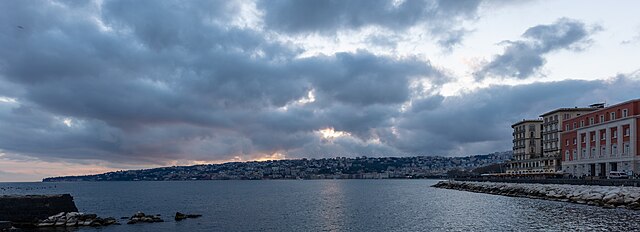
Naples' seafront promenade runs 3 km from Mergellina's fishing harbour in the west, past the Villa Comunale park (home to the Anton Dohrn Aquarium, Europe's oldest), to Castel dell'Ovo and Via Partenope. The classic route starts at Mergellina and heads east toward the castle, with Vesuvius on your left across the bay, Capri a distant silhouette on clear days, and the city's grand hotels lining the waterfront. It's best walked at sunset when the bay turns from blue to pink to gold — a ritual that costs nothing and pays out in spades.
Underground & Off-Beat
9. Catacombs of San Gennaro
Below the Rione Sanità district — a working-class neighbourhood with some of Naples' best Baroque architecture and its most authentic street life — lie the Catacombs of San Gennaro. Dating to the 2nd century AD, these two-level underground burial chambers house early Christian frescoes, the tomb of Saint Januarius (Naples' patron saint, whose relics were moved here in the 5th century), and a remarkable 5th-century mosaic portrait of San Gennaro himself — one of the earliest surviving images of the saint. Guided tours (€11, available in English) are led by young people from the Rione Sanità as part of a community regeneration project, and they're passionate, detailed, and well worth the detour.
10. Napoli Sotterranea — Underground Naples
Forty metres beneath the streets of the Centro Storico lies another city: a labyrinth of Greek-era quarries later used as Roman aqueducts, WWII air-raid shelters, and even illegal dumping grounds (cleared by volunteers in a remarkable 1990s clean-up). Napoli Sotterranea (Piazza San Gaetano 68) runs 90-minute guided tours through narrow tuff passages, candlelit chambers, and the remains of a Greco-Roman theatre where Nero is said to have performed. Not for the claustrophobic, but a fascinating perspective on the city's layered history — Naples has been digging beneath itself for 2,400 years.
Day Trips from Naples
11. Amalfi Coast
The Costiera Amalfitana — a UNESCO World Heritage Site and one of Europe's most spectacular coastlines — stretches 50 km along the southern side of the Sorrento Peninsula. The big three towns are Positano (vertical village of pastel houses cascading to a pebble beach — the most photogenic), Amalfi (historic maritime republic with the stunning Duomo di Sant'Andrea), and Ravello (perched 350m above the sea, home to the gardens of Villa Rufolo and Villa Cimbrone, whose Terrace of Infinity delivers one of the world's great views).
Getting there: Circumvesuviana train to Sorrento (65 min, €4.50), then SITA bus along the coast (Positano 40 min, Amalfi 70 min). In summer, ferries run from Naples Molo Beverello to Positano and Amalfi — longer but incomparably scenic. The bus is winding, crowded, and an experience in itself. Book Naples as your base and visit the coast as a day trip — much better value than Amalfi Coast hotels.
12. Capri
The island of Capri — 32 km offshore, 45 minutes by hydrofoil from Molo Beverello — has been a retreat since Emperor Tiberius ruled Rome from here in the 1st century AD. The unmissable sights: the Blue Grotto (a sea cave illuminated by an ethereal blue light — go early morning to avoid queues, and note it closes in rough seas), the Gardens of Augustus with views of the Faraglioni rock stacks, the chairlift to Monte Solaro (589m, the island's highest point), and the Piazzetta for the obligatory overpriced espresso and people-watching.
Capri is expensive — far more so than Naples — and summer day-tripper crowds can be extreme. Go in May, June, or September for a better balance. Hydrofoils run year-round but with reduced frequency in winter. Round-trip ticket ~€45. Book your Naples hotel through IMPT and use the savings for that Capri splurge.
13. Royal Palace of Caserta
Forty kilometres north of Naples (40 min by train from Napoli Centrale, €4.50), the Reggia di Caserta is the largest royal palace in the world by volume — 1,200 rooms, 34 staircases, 1,742 windows, and gardens stretching 3 km through fountains, cascades, and statues inspired by the palace of Versailles (which it was built to rival). Commissioned by Charles VII of Bourbon and designed by Luigi Vanvitelli, construction began in 1752 and the palace served as the Bourbon court until Italian unification. It's a UNESCO World Heritage Site, and its scale is genuinely overwhelming — the grand staircase alone is a masterwork of perspective and light. Budget 3 hours, wear comfortable shoes, and bring your camera: the gardens are a photographer's dream.
A 3-Day Naples Itinerary
🌞 Day 1: The Historic Centre
Morning: Spaccanapoli walk from Via Pasquale Scura to the Duomo, coffee at Caffè Mexico. Midday: Cappella Sansevero (book ahead). Lunch: pizza at Sorbillo or Di Matteo. Afternoon: Naples Underground or Catacombs of San Gennaro. Evening: Piazza del Plebiscito, Royal Palace exterior, sunset at Castel dell'Ovo, dinner in Santa Lucia.
🏯 Day 2: Pompeii & Vesuvius
Take 8:30 Circumvesuviana to Pompeii. Morning: Pompeii archaeological park (arrive at 9:00 opening). Lunch near the site. Afternoon: bus to Vesuvius National Park, crater hike. Return to Naples by 18:00. Evening: dinner in the Centro Storico, gelato on Spaccanapoli.
🌴 Day 3: Day Trip
Option A: Capri (early hydrofoil from Molo Beverello, Blue Grotto, Monte Solaro chairlift). Option B: Amalfi Coast (train to Sorrento, SITA bus to Positano and Amalfi). Option C: Caserta Royal Palace (40 min train, 3-hour visit). Return to Naples for a final pizza dinner and a sfogliatella nightcap.